Opportunity
Approach
Ecosystem Catalysis
More than ten thousand years ago, humanity domesticated wheat in the Fertile Crescent and set in motion the effort that would come to define civilization: growing more food, more reliably, to sustain a growing people. That first surplus gave rise to cities, to writing, and to trade, and even today close to ninety percent of the calories we eat trace back to the crops first domesticated in that early wave of farming. How reliably we could grow food once set the limit on how far civilization could expand, and it remains just as decisive now for the food security of eight billion people. But as climates grow more volatile, predicting how a given crop will actually perform has only become harder. Advances in DNA sequencing, satellites, and seasonal forecasting now let us amass the data to breed more stable crops and match the best genetics to each field. The challenge that will define the 21st century is making humanity's greatest invention, agriculture, now work on unprecedented frontiers.
Leveraging integrating genomics, environment data, management practices, and seasonal forecasts to predict how different crop varieties will perform. Sequencing has made genetics cheaper to obtain, environment data is now more accessible than ever through satellites, drones, and weather stations, and seasonal forecasts have grown reliable enough to inform variety selection and management decisions. Management practices are one of the largest drivers of yield, yet the hardest input to model, since predictive models have historically reduced this qualitative knowledge to a few crude categories. Text embeddings change this, encoding it into a rich, continuous input to be weighted alongside genetics and environment in a single predictive model.
The Programmable Plants thesis targets more productive, resilient and sustainable crop systems through advances in gene editing technologies and synthetic biology. This approach addresses the challenge of deploying existing genetic diversity more effectively through AI prediction models.
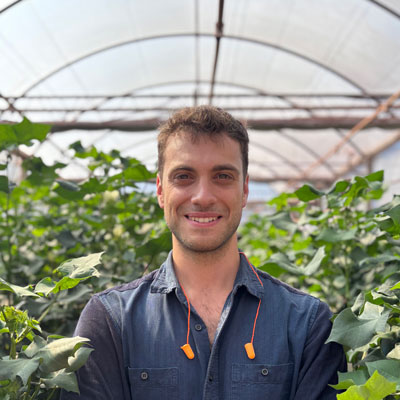
Undergraduate and Master's in Physics at the University of Oxford. Visiting Scholar at the Blue Marble Space Institute of Science, working on deep space food production simulations and reinforcement learning. Worked at startups and cooperatives across the agricultural sector in Australia and the UK. Passionate about food production, travelling to countries at the frontier of agriculture to learn on the ground.