The Work
Stachaczyk set out to build the first universal edge-autonomy software. With advisor Rika Antonova, she asked whether a resource-constrained edge platform can hold a serviceable model of its own execution on-board, a self-monitoring system, without a cloud round-trip or a global prior. The design borrows its structure from biological nervous systems: a failure shows up not in any single sensor value but in whether a platform's perception streams still stand in their learned relation to one another, on the reasoning that relations survive a change of platform where raw values do not. At the core is a metamodel, a shared latent world model trained on telemetry pooled across many robotic morphologies rather than one model per platform, so a new deployment draws on other platforms' operating history from day one while specialising to its own dynamics with use.
What Worked
The central result is that self-monitoring learned on one robotic morphology transfers to a different one, the first empirical support for the cross-operator corpus thesis. In controlled evaluation the metamodel outperformed per-platform custom models, a twin trained only on the target platform's own data, and general-purpose commercial foundation models carrying orders of magnitude more parameters. The fellowship produced a company, Pilgrims, rather than a paper alone.
What Has Been Achieved
The work spun out into a company, Pilgrims, with a workshop benchmark in preparation for NeurIPS 2026.
What Was Learned
AI could not substitute for physical deployment data; generating it in simulation proved futile early on. Distilling and quantising leading foundation and world models onto a single H100 or a Jetson Thor lost too much performance to be usable at inference. The binding limit turned out to be non-technical: operators who hold diverse logs have no established reason, and several disincentives, to release them.
About
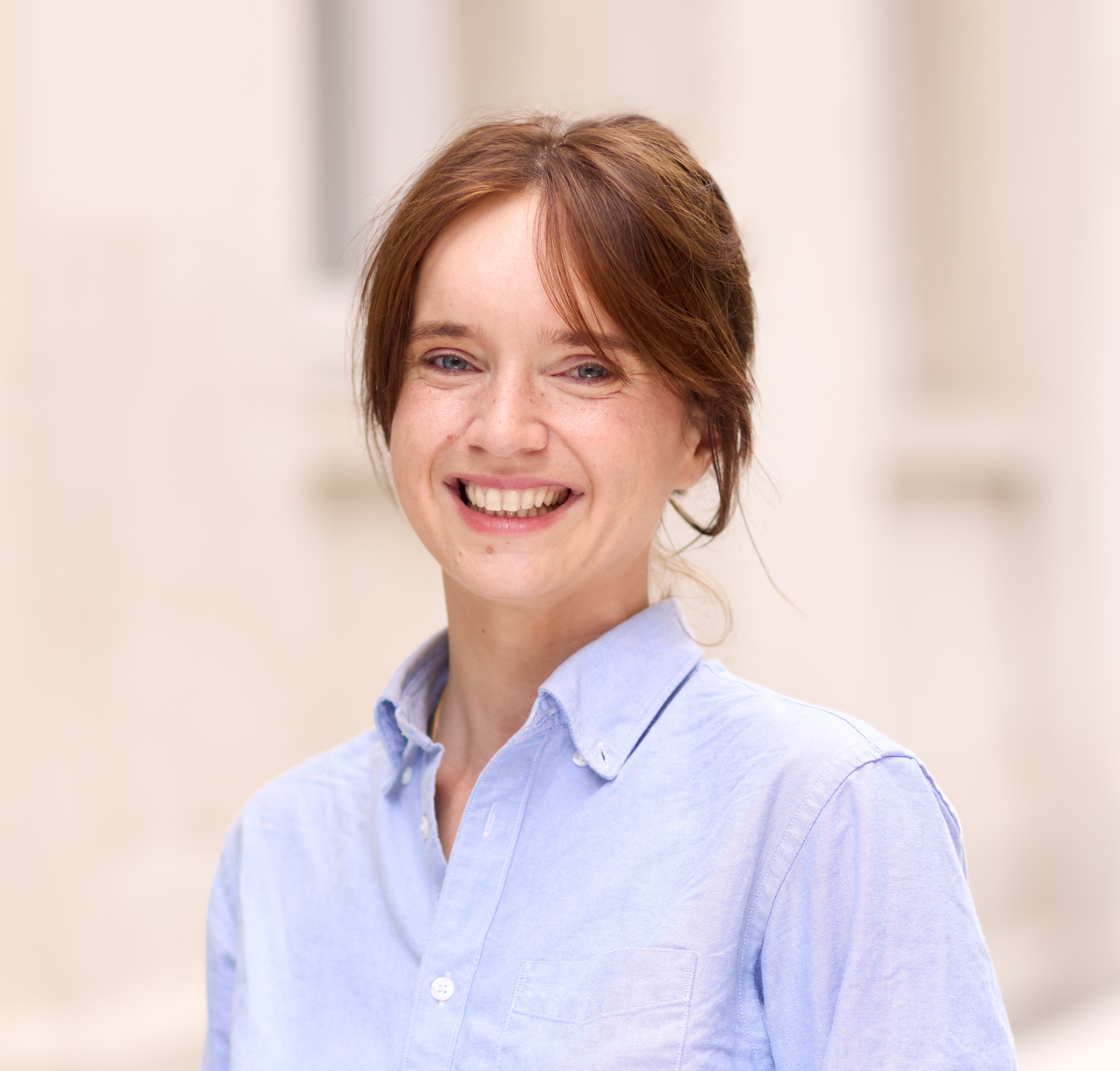
Martyna holds a PhD in Engineering Science from Imperial College London. She works in advanced AI agent design and mechanistic interpretability and previously worked at the Leverhulme Center on embodied intelligence for human-AI alignment.
Lab & Advisors

Rika Antonova
Unversity of Cambridge
Rika Antonova is an Associate Professor at the University of Cambridge. Previously, she was a postdoctoral scholar at Stanford University upon receiving the NSF/CRA Computing Innovation Fellowship, and worked with the Interactive Perception and Robot Learning Lab headed by Jeannette Bohg.